Speaker: Dominique Boust is president of the Querqueville Astronomy Group and a board member of the French Astronomical Society. He has been involved in popularizing the sciences of the universe for about fifty years.
Initially a matter of survival—when it was used to time sowing and harvesting or to mark the hours for rituals and prayers—the mastery of time has been a constant pursuit of human civilizations. The desire for supremacy among maritime powers turned it into a strategic and economic issue. With the development of international trade and advances in transportation, time ceased to be a local concept and became standardized on a global scale. At the dawn of the 20th century, it even ceased to be absolute; it can expand. Without mastery of this unique property of time, it would be impossible to synchronize the clocks of satellite geolocation systems, manage telecommunications, or conduct banking transactions.
For centuries, people literally read time from the apparent movements of the Sun and the stars. Until the mid-20th century, it was astronomers who established a standard of time based on the Earth’s rotation, which ultimately proved to be less uniform than hoped. Physicists then took over by building increasingly sophisticated atomic clocks. Today, time is the physical quantity measured with the greatest precision: less than one second of deviation in a billion years!
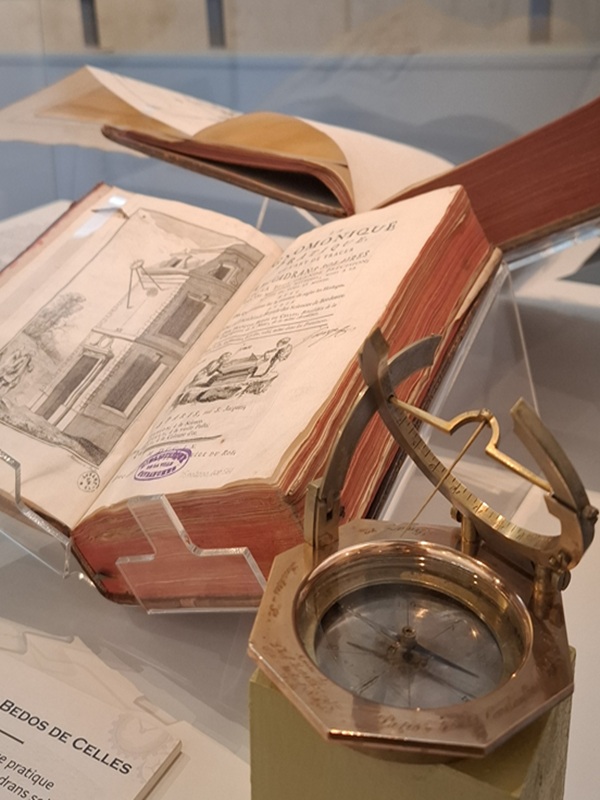
The lecture will introduce the key figures and instruments that have marked the history of time measurement and preservation: gnomons, sundials, astrolabes, clepsydras and hourglasses, pendulum clocks, mechanical clocks, and quartz clocks?
Date
| Days | Opening hours |
|---|---|
| Vendredi | 18h00 à 19h00 |